
Since the Yom Kippur War, Israel has witnessed many of its soldiers returning home from campaigns with severe injuries and posttraumatic stress disorder (PTSD). PTSD is a severe mental health problem – a trauma and stressor related disorder that causes intense fear, helplessness, and often horror. Those who suffer from PTSD constantly re-experience a traumatic event, causing them to avoid, most normal life activities. They have difficulties in falling asleep, and when they do go to sleep, they frequently awaken from nightmares and anxiety dreams. They experience extreme physiological tension, and lose the ability to concentrate, as well as finding that they have lost control over many of their bodily reactions. In order to reach a peaceful state of mind, veteran sufferers often engage in fruitless efforts, avoid difficult thoughts, places, situations and developing any personal relationship. They are left feeling as if a gun is always at their head, which leads to a protracted sense of failure and defeat, and powerless. Losing control of their lives, their quality of life regresses to emotional numbness and mental pain and in some situations, hopelessness.
Currently, there is enormous stress on traditional medicine and medications, which often are unable to reduce or eradicate the problems. Healthcare workers and physicians are looking for new ways to prevent PTSD or rehabilitate patients. Equine Assisted Activities and Therapy (EAA/T) appears to be an excellent non-invasive intervention that provides both prevention and an integrated rehabilitation experience for PTSD sufferers. As a broad scale holistic therapy, EAA/T succeeds in reducing or eliminating most of the manifestations that are intricately interlaced.
EAA/T is a task-oriented treatment that takes place in a normal non-threatening environment. Practitioners partnering with the horse leverage the human-horse connection to reduce PTSD symptoms. EAA/T, through groundwork and horseback riding activities, specifically empowers and motivates sufferers, improving their quality of life. EAA/T provides an outdoor activity where sufferers engage positively with a horse diminishing emotional numbness and normalizing a negative arousal state allowing for a new sense of belonging. During EAA/T sessions, PTSD sufferers reduce tension, restlessness and anxiety attacks. They start to feel that they are again in control of residual emotions and fears, opening doors for new interpersonal relationships with family, friends, and spouses.
What is PTSD
PTSD is a trauma and stressor related disorder that is caused by unwanted and repeated memories of the life-threatening events. The current conflicts globally are increasing awareness of the acute and chronic effects of Post-Traumatic Stress Disorder (PTSD). Many veterans returning from combat zones with PTSD symptoms have been exposed to rocket fire, explosions, gunshots, falls, and vehicle accidents. The memories of these unwanted and repeated life-threatening events exacerbate anxiety and amplify the PTSD symptoms.
Upon returning home, they carry a sense of shame, and sometimes guilt about what happened. This state of mind can result in losing friends, emotional withdrawal, isolation and disconnection. Those with PTSD symptoms may feel depressed, nervous, or agitated or not know what they feel. They have difficulty concentrating, planning ahead, and keeping relationships. They are unable to engage in normal sexual activities, sleep; and are often hypersensitive to noise or light.
Over a period of time, if not treated, PTSD becomes a chronic condition where all the symptoms become exaggerated. Chronic PTSD can lead to other health problems such as substance abuse, and lack of sleep, nightmares, obesity or anorexia. The avoidance of thoughts, places, situations and interpersonal relationships leads to a protracted sense of failure and defeat. Avoidance becomes the norm and loss of connection to reality may even lead to suicide.
PTSD can produce changes in cognition such as memory and concentration. Extreme physiological tension, loss of ability to concentrate, exaggerated responses to mental and physical challenges and poor control over bodily reactions leads to sufferers engaging in fruitless efforts to reach a peaceful state of mind.
The DSM describe the Negative Symptomology for PTSD as the following
- Trauma and stressor related
- Raised hyper-arousal level
- Sleep problems, nightmares, lack of sleep
- Depression
- Sexual dysfunction
- Problems of communication and the ability to connect emotionally and socially to other living beings
- Loss of social skills, difficulty in finding a voice to express thoughts, wishes, needs
- Emotional numbness
- Poor self-image and body awareness
- Loss of belief in abilities
- Loss of experience joy, pride and peace.
(Diagnostic and Statistical Manual of Mental Disorders, DSM-5, American Psychiatric Association, 2018)
The Aims and Goals of EAA/T
The aims and goals of EAA/T are to reduce symptoms of PTSD and build new strengths to repair and renew lives by empowering and strengthening self-esteem, and motivation, and providing them with an environment of trust, success and kindness. Any program aimed at helping veterans must ultimately help them cope with their real-life issues.
Methodology
The EAA/T method is holistic and manages both the psychological and physical needs of sufferers. The human-horse pairing taking place during any program characteristically treats the whole person by taking into account social and behavioral factors, as well as the symptoms of PTSD.
Using special groundwork and horseback riding techniques, veterans are paired with a specific horse in a non-judgmental and non-threatening environment. The horse is communicating trans-species and responds very quickly to the veteran’s personality and PTSD symptomology. This allows the PTSD sufferer to find a new direction to his or her life, through new skills like horse care and management and horseback riding. Flashbacks, negative emotions, and avoidance soon fade and are replaced by trust and caring and commitment, which, in turn, opens doors to new emotions and feelings. Once this happens, thoughts and actions that reduce overload and lack of focus can come into play. These new thought action repertoires and focus make it possible for a veteran with PTSD to navigate a social environment that includes family, friends and work.
Effectiveness of an EAA/T Program
In Israel, in 2011/2012, at the Israel National Therapeutic Riding Association (INTRA), I, partnering with the INTRA staff and horses, carried out a qualitative pilot study to analyze the impact of EAA/T for veterans with PTSD. Twenty-one participants were treated with EAA/T for a period of 40 weeks. Using globally recognized tracking questionnaires for sufferers with PTSD and cross-checked with instructor reports and some videos, the analyzed results demonstrated a major decrease in depression, decrease in negative dreams, and a decrease in hyper-alertness. The three questionnaires were the Beck Depression questionnaire, WHO-QOL questionnaire for the quality of life and the PCL-M relating to complaints and problems veterans have suffering from PTSD.
Each question was presented to each rider every 10 weeks. Using a scale from 1-4 or 1-5, with 1- being bad and 5 good, there was a reduction in the following Metrics-Mean Scores:
|
Involuntary thoughts |
33% |
|
Bad dreams |
38% |
|
Relive traumatic event |
13% |
|
Feeling bad when mentioned |
41% |
|
Think about incident |
50% |
|
Avoid situations |
54% |
There was significant improvement in communication and interaction skills with friends and families, the quality of life, bringing families back together. In addition, this increased motivation and self-worth resulted in the return to work of three participants. One other participant got married and now has had his first child, while another man has taken work in a horse farm.
Quote from spouse: “You have returned my husband to me.”
The indices for success were measured by:
|
a) A change and improvement of at least 25% in PTSD symptoms (to be demonstrated by schema and analysis of the data of the PTSD Checklist questionnaire – PCL (Keane, Weathers et al., 1993) – proved in the past in prospective research studies on the subject of treating post-traumatic stress disorder) b) A change and improvement of at least 30% in quality of life (to be demonstrated by schema and analysis of the data of the WHOQOL questionnaire – Quality of Life Enjoyment and Satisfaction Questionnaire (Endicott J. et al., 1993) |
|
c) Change and improvement of at least 25% in the symptoms of depression (the Beck Depression Scale, a self-testing tool approved for use in therapeutic research in Israel and abroad) |
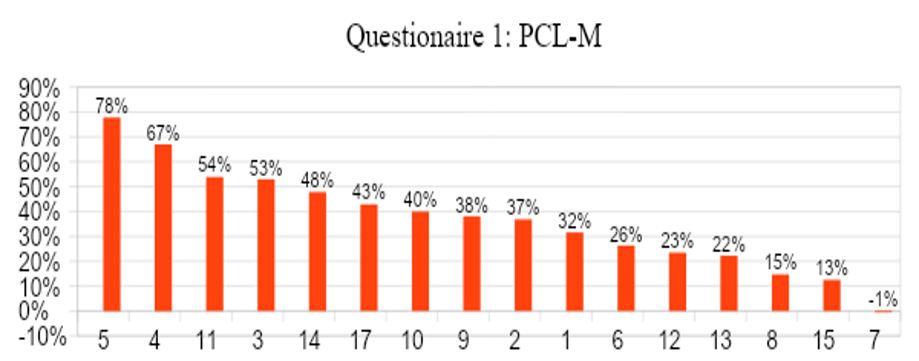
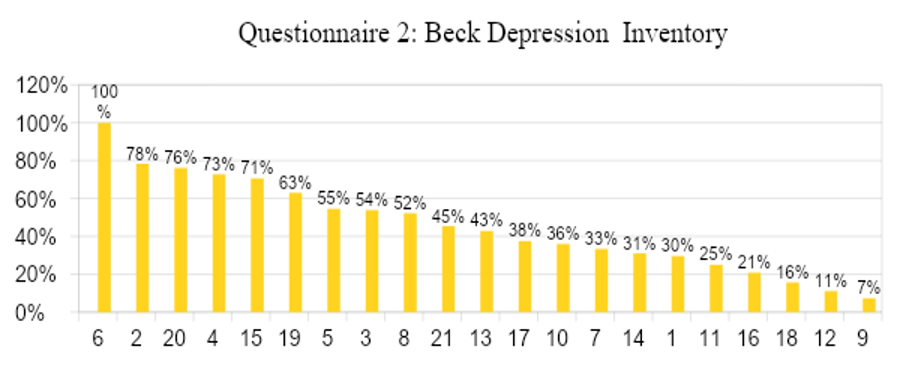
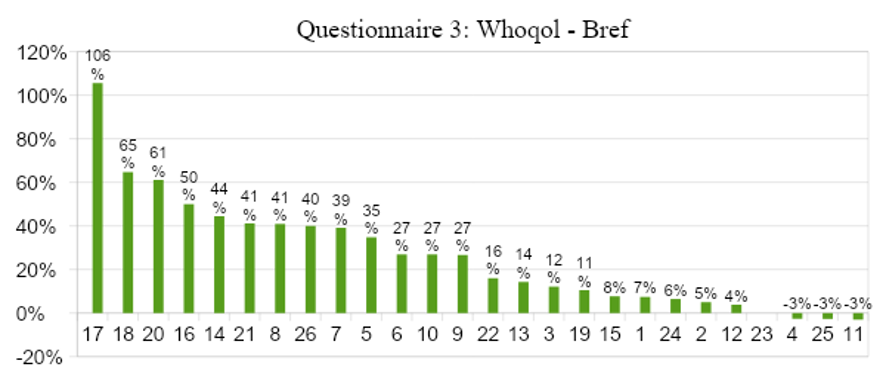
Graphs 1-3: Represent questionnaires: PCL-M, Beck Depression Inventory and Whoqol Bref. Each questionnaire shows improvements made by participants in the pilot study. The baseline numbers in each graph represent the question number in each separate questionnaire (See references: for access to questionnaires).
The PCL-M questionnaire is a self -reporting measure that assesses 20 DSM-5 symptoms of PTSD. It has a variety of purposes, including:
- Monitoring symptom change during and after treatment
- Screening individuals for PTSD
- Making a provisional PTSD diagnosis
The bottom line (X Axis) of the graph shows the independent variable (question numbers) and the side-line, (Y Axis) dependent variable.
The Beck Depression inventory, created by Aaron T Beck is a 21 multiple-choice self-reporting inventory, and is one of the most widely used in psychometric testing.
The bottom line (X Axis) of the graph shows the independent variable (question numbers) and the side-line, (Y Axis) dependent variable.
The WHOQOL-100 quality of life assessment was developed by the WHOQOL Group, in an attempt to develop a quality of life assessment that would be applicable cross-culturally.
The bottom line (X Axis) of the graph shows the independent variable (question numbers) and the side-line, (Y Axis) dependent variable.
Summary
Equine Assisted Activities and Therapy leads to significant improvement and alleviation of on-going distress and disability from PTSD sufferers in a number of ways. Positive changes take place in sleep patterns, there is a reduction of involuntary dreams, recurring negative thoughts and an improved ability to go to sleep. There is considerable improvement in the cardio-vascular system improving physical health. There is also a significant improvement in mental stress with a more positive reaction to anxiety, an ability to manage tension and more. After forty weeks of activities and therapy, PTSD sufferers were able to normalize and have successful personal relationships. Human-horse bonding carried out through specific groundwork and horseback riding activities had a positive effect on reducing PTSD symptoms. The holistic powers of the horse gave rise to new human powers enabling sufferers to keep up with the struggle to succeed. Sufferers stop feeling like a “broken tool” that has no impact on the world, they were empowered, motivated by a sense of achievement. Their physical, psychological, emotional, behavioral and cognitive progress, both in the arena and at home, reached a new and satisfying reality.
As practitioners we cannot forget for a moment how many individuals are suffering from traumatic events. Connecting with a horse through EAA/T reaffirms an individual’s belief in self. They can once again have fun and smile, while enjoying the ride. They can have moments of joy, pride and peace from the chaos that was in their heads and at last feel a sense of healing.
In the spring of 2020, I will publish my new book about the efficacy of EAA/T for those suffering from PTSD. Although veteran sufferers are most talked about, there are thousands of individuals who suffer from severe traumatic events and develop PTSD. In the book I will explain how the human-horse bond, can help all of these individuals.
Dr Anita Shkedi
EdD., MA., HV., SRN., RSCN., Obs, Therapeutic Riding Instructor.
Award of Excellence 2015 International Jewish Sports Hall of Fame.
Author: Traumatic Brain Injury and Therapeutic Riding
Anitashkedi@gmail.com
References.
- Beck Depression Inventory ibogaine.desk.nl/graphics/3639b1c_23.pdf
- Diagnostic and Statistical Manual of Mental Disorders, DSM-5, American Psychiatric Association, 2018
- DSM V version of the PCL, “PTSD Checklist Questionnaire” (Keane, Weathers et al, 1993)
- WHO | WHO Quality of Life-BREF (WHOQOL-BREF)who.int/substance_abuse/research_tools/whoqolbref/en/